MATH-PT: A Math Reasoning Benchmark for European and Brazilian Portuguese
·72 words
A benchmark of 1,729 native Portuguese math problems (European and Brazilian variants) for evaluating mathematical reasoning in modern language models.
PROPOR 2026
A curated list of publications across probabilistic machine learning, Bayesian modeling, GFlowNets, causal discovery, and trustworthy AI.
Use categories and topics to filter by venue and theme.
A benchmark of 1,729 native Portuguese math problems (European and Brazilian variants) for evaluating mathematical reasoning in modern language models.
PROPOR 2026
A workshop paper proposing orthogonal gradient projection for continual LLM unlearning in recursive self-improvement settings.
ICLR 2026 Workshop on AI with Recursive Self-Improvement
A principled framework for tensor rank identifiability based on prior predictive moment matching, with closed-form estimators for identifiable tensor models.
AISTATS 2026
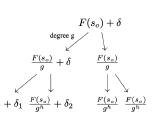
Analysis of the limitations and stability of GFlowNets under balance violations, showing how these affect accuracy. We introduce a novel metric for assessing correctness, improving evaluation beyond existing protocols.
ICLR 2025 (Spotlight, ~top 5% 🎉)
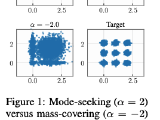
Novel approach to training Generative Flow Networks (GFlowNets) by minimizing divergence measures such as Renyi-$\alpha$, Tsallis-$\alpha$, and Kullback-Leibler (KL) divergences. Stochastic gradient estimators using variance reduction techniques leads to faster and stabler training.
NeurIPS 2024 (Poster)
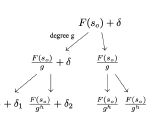
How balance violations impact the learned distribution, motivating an weighted balance loss to improve training. For graph distributions, there are scenarios where balance is unattainable, and richer embeddings of children’s states is needed enhance expressiveness. To measure of distributional correctness in GFN we introduce a provable correct novel assessment metric.
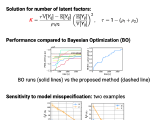
A method for prior specification by optimizing hyperparameters via the prior predictive distribution. This approach matches virtual statistics generated by the prior to certain target values. We apply it to Bayesian matrix factorization models, obtaining a close-formula for the rank of the latent variables, and analytically determine the matching hyperparameters, and extend it to general models through stochastic optimization.
JMLR 2023
ICML 2024 (Poster, Journal Track)
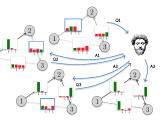
We introduce a causal discovery method that estimates uncertainty and refines results with expert feedback. Using generative flow networks, we sample belief-based ancestral graphs that captures latent-confounding, and iteratively reduce uncertainty through human input, with a human-in-the-loop approach.
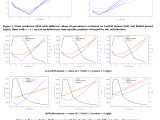
A joint model combining a Hierarchical RNN for session-based recommendations and a Point Process model for predicting return times. This approach improves both recommendation accuracy and return-time predictions over strong baselines.
WSDM 2019 (Poster)
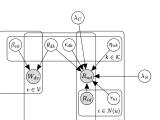
A latent variable probabilistic model for recommender systems that combines social trust, item content, and user preferences into a unified Poisson matrix factorization framework. This model jointly factorizes the user–item interaction matrix and item–content matrix, accounting for social relationships and content information to enhance recommendation accuracy. ECML 2017